
| Naoko,
a major bestseller and film in Japan, is a poignant and wily take
on gender relations from a master of the detective story. Expertly
and seamlessly interweaving the real and the unreal, Naoko
involves a regular guy whose world is rocked when his wife dies
in a bus accident. His young daughter survives, but seems to be
inhabited by her mother’s personality.
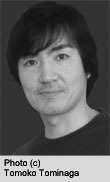
Keigo
Higashino was born in the lowest of lowly ghettos in
Osaka, to poor parents, in a tiny house that in his words was,
"always one room short." He lived off hand-me-downs,
and from girls at that. Always lonely, he took to reading massive
amounts of fiction- anything he could get his hands on.
Higashino's debut work, a collection of stories called After
School, won the prestigious Edogawa Rampo Award for best
horror/mystery, and Naoko has been turned into a blockbuster
film ("Himitsu" or Secret in Japanese).
Higashino explains the premise of Naoko and the idea
behind the main character:
“The basic premise of the story came to me while I was in
the work world. I read in a book somewhere about people who die
in accidents and about a young child who possesed the memories
of someone who died nearby. This motivated me to write the story.
The first thing I wondered about was sex in a situation where
a lover’s soul resides in the body of a small girl. I mulled
over it for some time, and tried it out as a short story, but
the ideas didn’t fully materialize. Finally I presented
it as a novel and it got picked up…
“Protagonists in mystery fiction have to be smart to figure
things out, so they end up being heroic. However, this protagonist,
Heisuke, is altogether lame. Writing him was a lot of fun.”

|
“Higashino
is a deft conjurer of human relationships, and while this is first
and foremost a tale of grief -- thankfully, no one calls Naoko
a story of redemption - he infuses it with spasms of sharp humor.”–East
Bay Express
“The
novel flips suddenly...in wonderfully pleasing fashion, from pathetic
tragedy to social satire and domestic comedy with themes of love,
work, sex and education.
How could
we have ever imagined, without the help of a novel like this,
that Japanese life could be so fraught with suffering and so entertaining
all at once?”
–Alan
Cheuse for the Dalls Morning News
From Naoko:
He didn’t
see it coming. At all.
Heisuke came home
from his night shift at exactly 8 a.m., entered the small tatami
room, and turned on the television. All he wanted was to hear
the results from the big sumo tournament the day before. He would
turn forty this year; he believed without doubt that today would
be as ordinary, and as quiet, as the preceding thirty-nine-odd
years had been. It was more than a belief: as far as he was concerned,
it was an established fact. A reality more immobile, more immutable
than the great pyramids themselves.
So he couldn’t
foresee, while he was changing the channel, that the news appearing
on the screen would unnerve him in any way. And even if something
were to happen that turned the world upside down, he was sure
that it would have no direct effect on him.
He switched to
the program that he always watched after a night shift, a variety
show that covered show business scandals, sports news, and the
events of the past day with both breadth and superficiality. The
host was a freelance announcer popular with housewives. He had
a kindly, avuncular face, and Heisuke didn’t dislike him.
What appeared
on the screen, however, was not the host’s smiling face,
but a snow-covered mountain somewhere. The scene was being shot
from a helicopter, and the voice of the man giving the report
was muffled by the sound of whirling rotors.
“Something
must have happened,” was all that he thought. Something
must have happened, and he had no interest in knowing what. All
Heisuke wanted to know at that moment was whether or not his favorite
wrestler had won, because this tournament would decide whether
he would be promoted ozeki or not.
Heisuke put his
company jacket on a hanger and hung it on the wall-mounted coat
rack. Rubbing his hands, he entered the adjoining kitchen. Since
the heat hadn’t been on all day the floorboards were freezing
cold. He quickly shuffled into his tulip-patterned slippers.
|