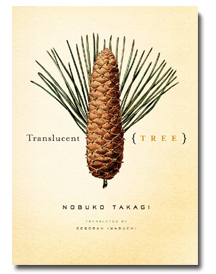
\
| \
Chigiri, \
a divorced single mother, lives in the countryside town where \
she grew up, caring for her sword-smith father whose trade and \
health are failing. Her life seems to be going nowhere. When a \
documentary filmmaker who worked on a piece about her father many \
years ago revisits the town, Chigiri, who was still a high school \
student back then, begins to feel like one again. Yet feelings \
aren't where it ends when a half-serious offer of prostitution \
is floated between the financially desperate Chigiri and Go, the \
visitor, who has since become successful in Tokyo. \
With a philsophical acumen and \
exaltation of passion reminiscent of Yukio Mishima, Milan Kundera, \
and Marguerite Duras, Translucent Tree follows the story \
of mature lovers for whom, despite all, innocence is never a thing \
of the past. \
\
\
| \
“Nobuko \
Takagi writes with a fluidity that complements the hard, metallic \
background story about swords and daggers and the families that \
made them. Her descriptions of sex, especially, sluice through \
the reader’s conscious with careful deftness.”
\
—ForeWord magazine \
No romance \
novelist enjoys more critical accolades than author Nobuko Takagi, \
who won the prestigious Akutagawa Prize when she made her debut \
in 1984. In this novel, penned nearly two decades later, Japan’s \
queen of love stories harkens back to her roots in literary fiction \
to offer a tale as exquisite as it is torrid. Translucent \
Tree not only won the Tanizaki Award, granted to the best \
literary novel of the year, but also garnered further acclaim \
as a successful feature film. \
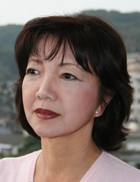 After \
working as an editor, Nobuko Takagi won the Akutagawa Prize in \
1984 and became a professional writer in her thirties. In addition \
to the Tanizaki Award for Translucent Tree, she has been \
the recipient of the Women’s Literature Award and the Minister \
of Culture Award. Translucent Tree is her first novel \
to appear in English. The author lives in Fukuoka, Japan. After \
working as an editor, Nobuko Takagi won the Akutagawa Prize in \
1984 and became a professional writer in her thirties. In addition \
to the Tanizaki Award for Translucent Tree, she has been \
the recipient of the Women’s Literature Award and the Minister \
of Culture Award. Translucent Tree is her first novel \
to appear in English. The author lives in Fukuoka, Japan.
\
| \
\





 \
\